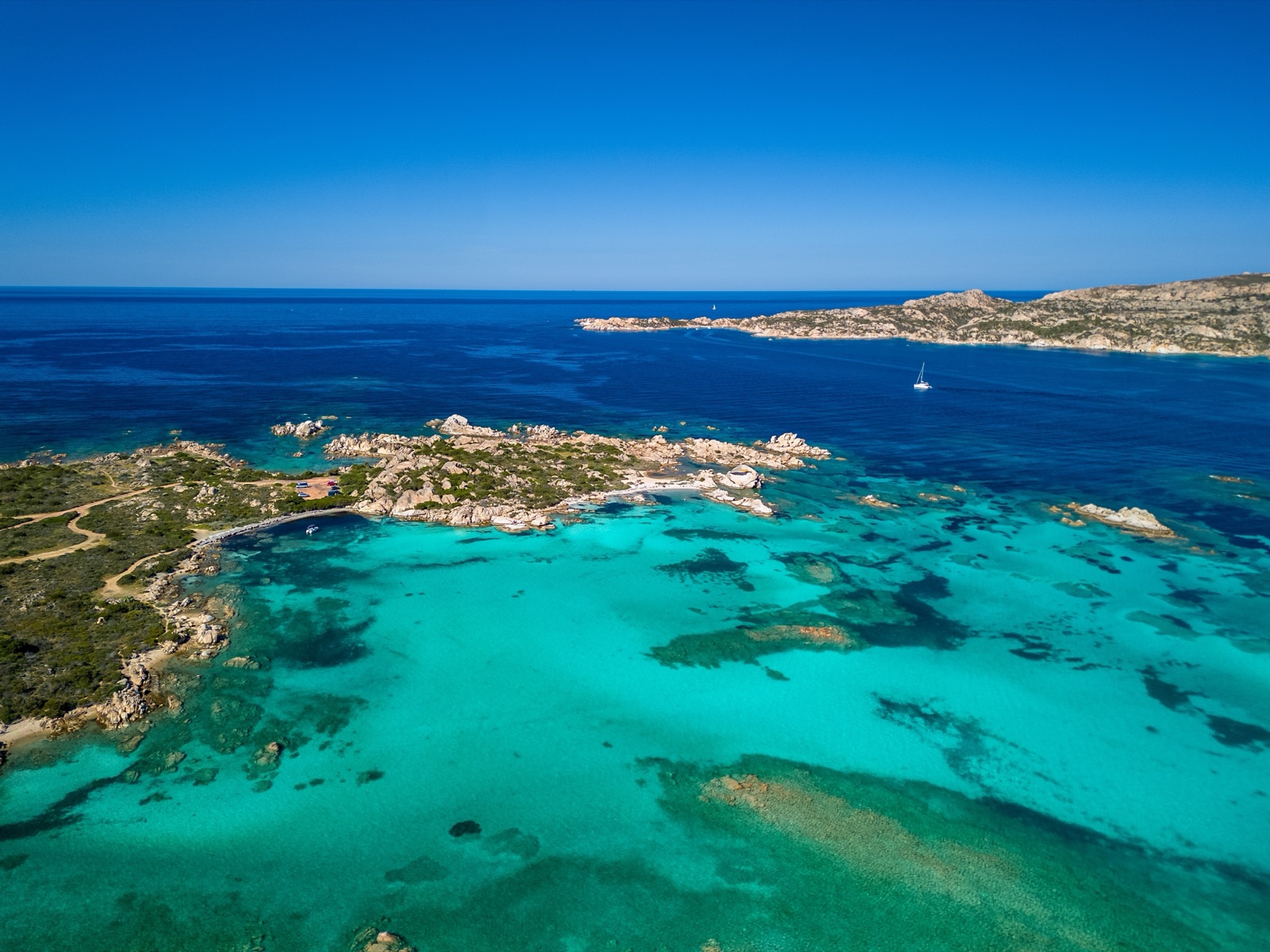
Snorkelling and Diving at La Maddalena: Secca Washington, Spargi and the Park Rules
The La Maddalena archipelago is one of the best places in Italy to look under the water. Snorkellers can swim straight off beaches such as Cala Spalmatore or join a boat trip to coves like Cala Corsara, while scuba divers go out with a dive centre to granite shoals such as the Secca di Spargi, also called Secca Washington, where big groupers and barracuda come close. Because the whole archipelago is a national park, diving needs a park permit, which dive centres arrange, and some areas are closed to swimmers and divers altogether.
This guide covers the park’s described dive sites with their depths, the best places to snorkel from the shore and from a boat, the permits and rules, what lives here and how to stay safe.
Why the water is so good here
- More than 110 species of land vertebrates and some 500 marine species live in the park, including the strictly protected dusky grouper.
- About 78% of the park is sea, and it is part of the sanctuary for marine mammals.
- Granite dominates above and below the surface. Wind and water have carved it into towers, gullies and overhangs, which is what makes the dive sites so varied.
- Sardegna Turismo singles out the shallows of Spargiotello and Washington, Punta Coticcio and the Grottino di San Francesco for divers.
Protection is the other reason. Fishing is banned in large areas, and the fish behave accordingly: groupers that would flee elsewhere hang in the water and watch you.
The rules first
Before you dive or snorkel, know what the park allows.
- In the park, sports, fishing and diving are allowed but need permission first.
- Since summer 1999 the park has charged a ticket to private boaters, passenger boats, dive centres and divers. If you dive with a dive centre, the centre handles this; if you dive from your own boat, you need your own permit.
- Fishing and diving permits can also be applied for in person with the park’s form. Payments to the park can be made only through the national PagoPA platform.
- In the zones of full marine protection, navigation, anchoring, swimming and fishing are forbidden; the Pink Beach is an example.
- The sea between the beach and Isola della Pecora is an integral reserve: navigation, mooring, fishing and scuba diving are forbidden. That is the water off the Spiaggia del Relitto on Caprera.
- Dumping waste or sewage into the sea is forbidden, and so is taking sand, shells or other natural materials. Do not touch or collect anything underwater.
The park’s dive sites
The park describes six dive sites in its own itineraries, several of them with mooring buoys so that boats do not anchor on the seabed. All are reached by boat, normally with a dive centre.
| Site | Where | Shallowest point | Deepest | Highlights |
|---|---|---|---|---|
| Secca di Spargi (Washington) | Off Spargi | About 6 m | Just over 25 m | Groupers, barracuda, red gorgonians |
| Scoglio di Spargiotto | North-west of Spargi | About 3 m | 26 m | Dusky groupers, Posidonia, gorgonians |
| Scoglio del Pilastrino | Channel off La Maddalena | Near the surface | 25 m | Sponges, sea daisies, bream |
| Scoglio del Gotto | North of Barettinelli | Near the surface | About 25 m | Red gorgonians, morays |
| Picchi di Coticcio | East of Caprera | Varied | Varied | Granite spires, barracuda, amberjack |
| Scoglio di Mortoriotto | Off Mortorio, the far south | Shallow channel | 40 m | Coralligenous reef, false black coral |
Secca di Spargi (Secca Washington)
The archipelago’s best-known dive.
- The Secca di Spargi, or Secca Washington, is a large rocky rise whose top comes within 6 metres of the surface; the deepest points are just over 25 m.
- Dives start from four mooring buoys that reach to about 4 m below the surface. In good weather they are easy to find, and you can choose several routes around the rock.
- Large groupers, brown meagre, sea bream, dentex and barracuda are confident and easy to approach there, with red gorgonians in the deepest parts.
The contrast between the sunlit tops, covered in algae, and the shaded overhangs crowded with sponges and other animals is what makes this site special. It suits divers from beginner to experienced, depending on the depth you choose.
Spargiotto and the Spargi wreck
Scoglio di Spargiotto
- The Spargiotto rise comes up to 3 m from the surface.
- At Scoglio di Spargiotto a rise comes to 3 m from the surface, split by a sandy gully reaching 26 m; buoys at 5 m depth mark the start.
- At Spargiotto the mooring buoys are at 5 m depth.
- Shoals of salema and bream patrol the granite, with patches of Posidonia between the rocks and large, confident dusky groupers.
Above the water, the islets of Spargiotto and Spargiottello are protected nesting sites for seabirds such as Audouin’s gull and shearwaters, so do not land.
The Roman ship
Off Spargi lies a Roman cargo ship of the 2nd century BC at a depth of 18 metres. In 1939 a diver found a Roman ship of about 110 BC on the Corsara shoal at 18 m; around 2,000 amphorae and ceramics are now in the Nino Lamboglia naval museum on La Maddalena. The cargo you can see today is in the museum in town rather than on the seabed, so visit the museum to complete the story.
Pilastrino and Gotto: close to La Maddalena
Two sites lie close to the main island, which means short boat rides.
- Scoglio del Pilastrino, in the channel between La Maddalena and the mainland, reaches 25 m but is rewarding from the first metres. Yellow sponges, sea daisies and bryozoans cover the granite, and the currents that run between the boulders bring food for filter feeders. A good site for newer divers.
- At Scoglio del Gotto the rock ends on a detritus bottom at about 25 m, with red gorgonians, large brown meagre and many morays. The dive moves from sunlit algae through shade to a deeper coralligenous zone.
Picchi di Coticcio
East of Caprera, below the famous cove:
- Picchi di Coticcio, east of Caprera, is sheltered from westerly and mistral winds and has three dive buoys; fishing is banned and boats may pass at no more than 3 miles.
- The seabed mirrors the island above: granite bastions, deep channels, spires and holed rocks shaped into strange faces.
- Look for salema, bream, barracuda and big groupers, with amberjack and dentex coming in from open water, and morays and scorpionfish in the shade.
Because it is sheltered from the mistral, this is often the site that goes ahead when others are blown out.
Scoglio di Mortoriotto: the deep one
- Scoglio di Mortoriotto, the park’s southernmost dive, slopes to a bottom at 40 m, with coralligenous reef and false black coral between 36 and 40 m.
- At Mortoriotto the seabed descends in steps to a detritus bottom at 40 m.
- Colonies of false black coral at such shallow depths are rare, which makes this a special dive for experienced divers with the right qualification.
- Sardegna Turismo picks out the seagrass around Scoglio di Mortoriotto among the Cannigione diving areas. Cannigione’s gently sloping seabed has made it one of Sardinia’s leading diving centres.
Snorkelling from the beach
You can see a lot with just a mask and fins.
- Cala Spalmatore on La Maddalena island: its sandy seabed slopes gently and suits both families and snorkellers. It is also sheltered from the north-westerly wind.
- Punta Tegge: the seabed turns rocky and deep almost at once, a favourite with divers. Better for confident swimmers.
- Cala Napoletana on Caprera: Cala Napoletana is three small beaches; its shallow, gently sloping sandy seabed is perfect for snorkelling. It is a walk or a boat ride away; see Caprera walks and hiking.
- Cala Coticcio: Cala Coticcio is a natural pool, full of fish and starfish, ideal for snorkelling, reached on a guided walk or by boat.
Our guide to the beaches you can reach by car covers getting to each one.
Snorkelling from a boat
Most visitors snorkel on a boat trip, which reaches the islands without roads.
- Cala Corsara, on Spargi’s south-east coast, is four beaches of very fine white sand among dunes, with the ‘Witch Rock’ on its western side, and is good for snorkelling.
- The natural pools of Budelli and Porto della Madonna are shallow and clear, though navigation there is restricted.
- The full-day boat trip from Palau stops at beaches such as Cala Corsara and Santa Maria and at the clear water of Cala Coticcio, with several swim stops.
When the boat is moored, swimming is allowed within 5 metres of the moored boat. Stay close, because other boats pass nearby.
Snorkelling on your own, on a boat trip or with a dive centre
| Option | Best for | What to know |
|---|---|---|
| From the beach | Families, a first look, low cost | Limited to the coves you can drive or walk to |
| Boat trip with swim stops | Reaching Spargi, Budelli and Caprera’s coves | Time in the water is set by the itinerary |
| Hired boat | Freedom to choose coves | Needs the park permit and knowledge of the zones |
| Dive centre | Scuba at the outer shoals | The centre handles the park’s diver ticket |
If you hire a boat to snorkel, remember that boaters need a park permit to navigate, moor, anchor or stop within 300 m of the coast; kayaks, pedalos and windsurf boards are exempt. Use the park’s mooring buoys where they exist rather than anchoring; our guide to boat hire explains the permit and the zones.
Underwater photography
- Light. The middle of the day gives the brightest colours in shallow water; Sardegna Turismo makes the same point about Cala Napoletana, where the middle of the day is best for its colours.
- Get low and close. Groupers on the outer shoals tolerate a slow approach; chasing them sends them into the rocks.
- Mind the bottom. Kneeling on rock or sand for a photo crushes the life on it. Keep your fins off the seabed and never stand on Posidonia.
- Housings and action cameras work well in the clear water here; a red filter helps below about 10 metres.
The museum on land
The archipelago’s underwater history is easiest to understand in town. The Nino Lamboglia naval museum on La Maddalena holds the cargo of the Roman ship found off Spargi. A visit before or after a dive at Spargi brings the story together. For the town and its museums, see our guide to La Maddalena town and Caprera.
What you might see
- Dusky grouper. The park’s emblem underwater, strictly protected and often curious.
- Fan mussel. The loggerhead turtle is easily found in the park, and the fan mussel Pinna nobilis, the Mediterranean’s largest bivalve, lives here.
- Dolphins. The most common cetacean is the bottlenose dolphin, seen in groups of up to thirty. You are more likely to see them from a boat than in the water.
- Posidonia meadows. The seagrass that holds the sand in place and shelters young fish; anchoring on Posidonia oceanica meadows or other sensitive habitats is forbidden.
- Gorgonians, sponges and sea daisies on the deeper and shaded walls.
- Barracuda, amberjack and dentex on the outer shoals.
Choosing a dive centre
Dive centres work from La Maddalena, Palau and the Costa Smeralda side.
- Choose a centre that holds the park’s permit for the season; the park keeps a yearly list.
- Ask which sites they plan to dive and the depth, and match it to your qualification. Mortoriotto at 40 m is not a beginner’s dive.
- Ask about wind: a good centre changes site rather than take you out in a rough sea.
- If you are new to diving, ask for a trial dive at a sheltered, shallow site such as Pilastrino.
When to go
The water is warmest from late spring to early autumn, and the calmest seas tend to come in summer. The park’s waters are busiest then too: every summer up to six thousand boats a day crowd the park’s waters, and popular snorkelling coves fill with boats by late morning. June and September often bring good visibility with fewer boats. In the colder months some dive centres close; check before you travel. Our best time to visit La Maddalena guide has the month-by-month climate.
Wind and safety
- The mistral blows from the north-west. It makes exposed sites rough; east-facing sites like Picchi di Coticcio are more sheltered.
- Currents run between the islands and through the channels; this is part of what makes the sites rich, and a reason to dive with a guide.
- Boats are the biggest danger to snorkellers. The speed limit is 7 knots within 500 metres of the coast, but always use a bright buoy or swim inside the buoyed bathing areas.
- Sun. A rash vest stops your back burning while you snorkel.
- Do not touch. Gorgonians, sponges and fan mussels are fragile and protected.
With children
Children who swim well can snorkel at Cala Spalmatore and Bassa Trinità, where the water is shallow and the sand gently shelving. A boat trip with several swim stops lets them try snorkelling in different coves without long walks. Under-age divers can only do dives suited to their age and certification; ask the dive centre.
What to bring
- A mask that fits, snorkel and fins; hire is possible but your own fits better.
- A rash vest or thin wetsuit; early and late in the season, a 5 mm wetsuit for diving.
- Reef-friendly sunscreen, applied well before you get in.
- Your certification card and logbook for scuba diving.
- A bright buoy for snorkelling away from the beach.
Frequently asked questions
Do I need a permit to dive at La Maddalena?
Yes. Diving in the national park needs permission, and the park charges dive centres and divers. If you dive with a dive centre, it arranges the permit.
What is the best dive site at La Maddalena?
The Secca di Spargi, also called Secca Washington, is the best known: a granite rise from about 6 m to just over 25 m, with confident groupers and barracuda.
Where is the best snorkelling on La Maddalena island?
Cala Spalmatore, whose sandy seabed slopes gently and suits families and snorkellers, and Punta Tegge for deeper, rocky water.
Can I snorkel at the Pink Beach?
No. The Pink Beach lies in a zone of full protection where swimming is forbidden; it can be admired only from the sea.