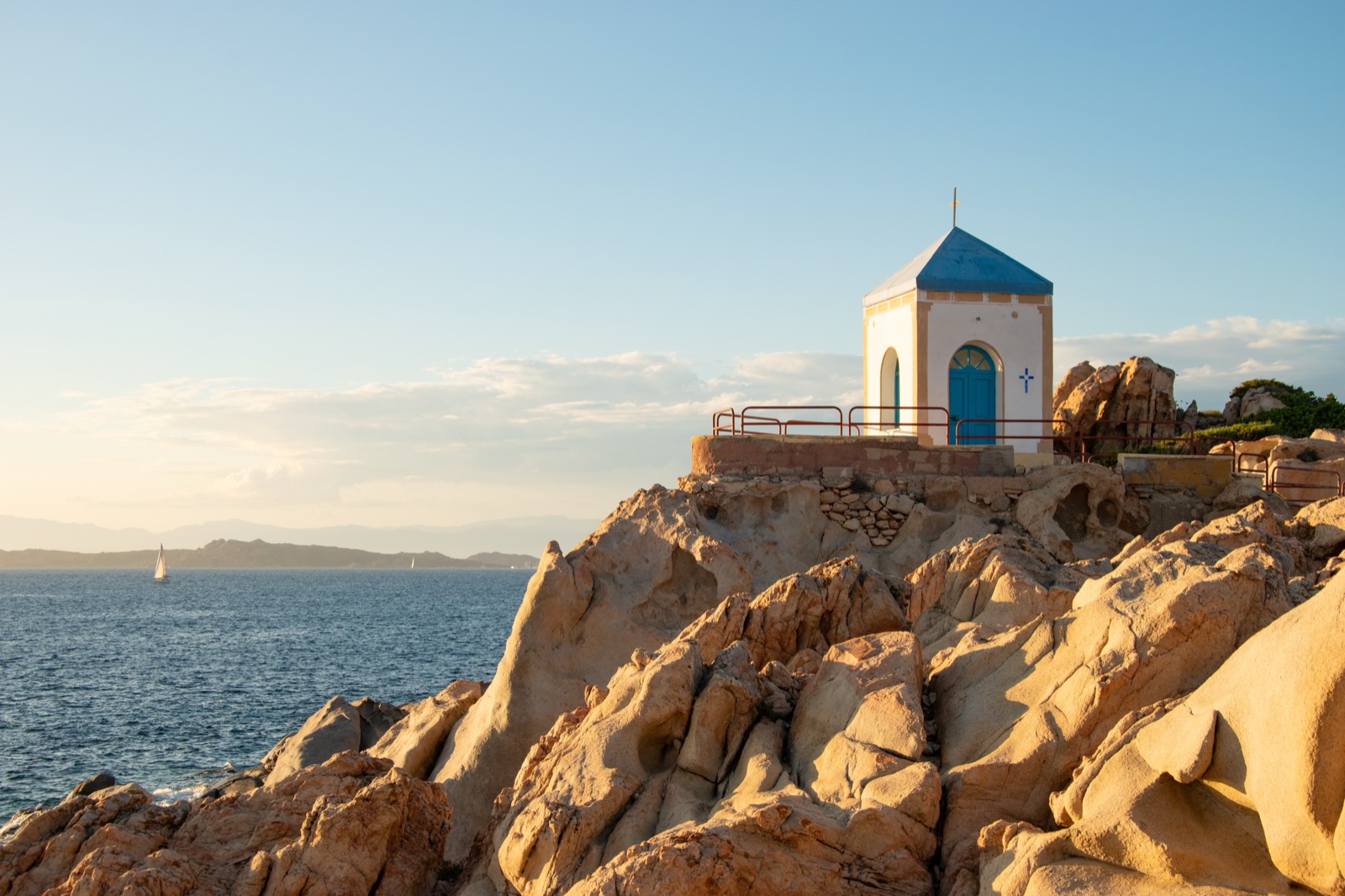
La Maddalena Beaches by Car: Bassa Trinità, Spalmatore, Caprera and the Ring Road
You do not need a boat to swim in the La Maddalena archipelago. The famous beaches of Spargi and Budelli are reached only by sea, but La Maddalena island and Caprera, joined by a bridge, have a string of beaches you can drive, ride or take the bus to: Bassa Trinità and Monti d’Arena in the north, Cala Spalmatore in the east, Punta Tegge and Cala Francese in the south-west, and Cala Portese and the Spiaggia del Relitto on Caprera. All of them hang off one ring road, so you can see several in a day.
This guide goes round that road beach by beach, with what each one is like, which wind it is sheltered from, the facilities you will find and how to choose between them.
The ring road
A road runs right round La Maddalena island: 45 kilometres of coast. It is the key to every beach on the island. From town it runs west along the Padule seafront, north past the Strangolato isthmus to the dune beaches, then east and back down towards the bridge to Caprera.
- To the north, beyond the Strangolato isthmus, are white-dune coves: Bassa Trinità, Cala Lunga and Monti d’Arena; to the south, along the Padule road, Nido d’Aquila and Punta Tegge.
- Cala Francese and its granite quarry are three kilometres from the town centre.
- Caprera is joined to La Maddalena by a 600-metre bridge built in 1958, and its beaches lie along the roads south towards Stagnali and Punta Rossa.
The beaches at a glance
| Beach | Island and side | What it is like | Facilities |
|---|---|---|---|
| Bassa Trinità | La Maddalena, north | Fine white sand, shallow water, dunes | Bathing facilities, parking, refreshments |
| Monti d’Arena | La Maddalena, north | Shallow water by a large white dune | Food, ample parking, buses, pedalo and boat hire |
| Cala Spalmatore | La Maddalena, north-east | Small sheltered cove, gentle sandy seabed | Bathing and refreshment services |
| Punta Tegge | La Maddalena, south-west | Coarse golden sand, deep rocky water | Water-sports hire, restaurant |
| Cala Francese | La Maddalena, west | Small rocky coves by an old quarry | Few; bring what you need |
| Cala Portese (I Due Mari) | Caprera, south-east | Two beaches back to back, white sand | Reached by car, bike or bus |
| Spiaggia del Relitto | Caprera, south-east | White sand and a wreck on the shore | Car park a short walk away |
Bassa Trinità
Bassa Trinità is the beach most people picture when they think of La Maddalena island.
- Bassa Trinità is on the northernmost stretch of the island’s ring road, sheltered by a 128-metre rocky spur once used as a battery.
- Its name comes from the Trinità church, built just after the occupation of 1767. The little church still stands above the beach, and the area is a place of devotion for islanders.
- Bassa Trinità has fine white sand and a sandy, shallow seabed, good for children and for a long, lazy swim.
- Bassa Trinità has bathing facilities, parking and refreshments, and a nature trail leads round the area.
The north coast catches the north-westerly mistral, so on a windy day the water here can be choppy while the east-facing coves stay calm. Climb the dunes behind the beach for the view over the smaller islands.
Monti d’Arena and Cala Lunga
A little further along the north coast:
- Monti d’Arena, on the north of La Maddalena between Punta Abbatoggia and Punta Marginetto, is named after a ten-metre dune of white sand.
- The water at Monti d’Arena is shallow over a sandy bottom.
- Monti d’Arena has a place to eat, ample parking and bus links, with pedalo and boat hire. It is one of the easiest beaches to reach without a car.
- Its constant wind makes Monti d’Arena popular with windsurfers. That same wind means it is not the place for a calm swim on a mistral day.
Cala Lunga, between the two, is another small bay of white dunes and wind-sculpted rock on the same stretch of road. The Abbatoggia headland nearby has a campsite and tourist village, so this corner of the island is busy in August.
Cala Spalmatore
If the wind is up in the north, head east.
- Cala Spalmatore is sheltered from the north-westerly wind, which makes it the island’s best bet on a mistral day.
- The beach at Cala Spalmatore is 70 metres long and 25 metres wide, one of the island’s busiest, with bathing and refreshment services.
- Its sandy seabed slopes gently and suits both families and snorkellers.
- Fishermen once landed at Spalmatore to coat their boats with pitch; a long pier recalls them. Small boats still moor in the inlet.
Spalmatore is close to the bridge to Caprera, so it pairs easily with an afternoon at Garibaldi’s home or on the Caprera beaches.
Punta Tegge and Nido d’Aquila
The south-west corner of the island is rockier and deeper.
- Punta Tegge, at the south-western tip, has coarse golden sand; the seabed turns rocky and deep almost at once, a favourite with divers.
- Punta Tegge has water-sports hire and a restaurant; it faces Spargi and Porto Rafael.
- The Santa Teresa fort above Punta Tegge was built in 1793, and the hill gives one of the best views on the island.
Nido d’Aquila, just along the Padule road, is a cluster of granite coves near another old battery. This side faces the sunset over Spargi, so it is a good place to end the day. It is not the best choice for small children, because the water deepens quickly.
Cala Francese and the granite quarry
Cala Francese is less a single beach than a series of small coves around a piece of industrial history.
- The pink-white granite quarry at Cala Francese worked until the Second World War and is now open to the public, with old rails, machinery, a little train and a crane.
- At Cala Francese the seabed is mostly sandy and deepens almost at once.
- Cala Francese and its granite quarry are three kilometres from the town centre, making it the closest swimming spot to town on the west side.
Bring water and shade: this is a wilder spot than Bassa Trinità or Spalmatore.
Caprera: Cala Portese, I Due Mari and the Relitto
Over the bridge, the beaches of southern Caprera are among the most beautiful you can reach by road.
Cala Portese and I Due Mari
- I Due Mari, two beaches back to back on an isthmus at the southern end of Caprera, also holds the Blue Flag.
- Cala Portese, the wide white beach also known as ‘I due mari’, lies in the south-east of Caprera and is easy to reach by car, bike or bus; the park’s trail 4 begins here.
- Cala Portese offers boats a sheltered landing on mistral days, so the beach often has a fleet of anchored boats offshore.
With two beaches facing opposite ways, one side is usually calmer than the other whatever the wind.
Spiaggia del Relitto
- On Spiaggia del Relitto lies the wreck of the motorsailer Trebbo, run ashore after a fire on 22 June 1955. The ribs of the boat still lie on the sand.
- The beach has held the Blue Flag for years.
- You can drive to it over the bridge, past Stagnali and along a dirt road to a car park about 250 metres from the beach.
- The sea between the beach and Isola della Pecora is an integral reserve: navigation, mooring, fishing and scuba diving are forbidden. You can swim from the beach, but you cannot snorkel out to the islet.
The beaches you cannot drive to
Some of Caprera’s best-known coves are reached only on foot or by boat.
- Cala Napoletana is reached on a park trail from the Arbuticci fort or by sea; the walk is in our guide to Caprera walks and hiking.
- Cala Coticcio and Cala Brigantina on Caprera lie in highly protected zones and can be reached on foot only with a licensed environmental hiking guide.
- Spargi, Budelli, Razzoli and Santa Maria are islands without roads. Spargi, the archipelago’s third-largest island, can be reached only by sea. For those, see our guide to boat trips and beaches or the boat tours.
Choosing by wind
Wind matters more than anything else when you choose a beach here. The mistral blows from the north-west and can turn the north coast rough in an hour.
| Wind | Where to go | Where to avoid |
|---|---|---|
| Mistral (north-west) | Cala Spalmatore, the sheltered side of I Due Mari | Monti d’Arena, Bassa Trinità |
| Easterly | North and west coasts: Bassa Trinità, Punta Tegge | East-facing coves |
| Calm | Anywhere; the dunes of the north coast are at their best | Nothing |
Check the forecast on the weather page on this site before you set off, and do not hesitate to change beach.
Getting around: car, scooter, bus and bike
- Car. Car ferries run to La Maddalena from Palau, so you can bring a hire car across. Parking is easy at Bassa Trinità and Monti d’Arena, harder at the small coves in August.
- Scooter. The ring road suits a scooter, and parking a two-wheeler at the busy beaches is much easier than a car.
- Bus. Monti d’Arena has a place to eat, ample parking and bus links, with pedalo and boat hire, and Cala Portese on Caprera is served by bus too.
- Bike. The island is hilly but the ring road is a fine day out by bike in spring or autumn. Caprera’s roads climb steadily from the bridge.
For the ferry crossing itself, see getting to La Maddalena.
Rules on the beaches
All these beaches lie inside the national park.
- Dumping waste or sewage into the sea is forbidden, and so is taking sand, shells or other natural materials. That includes the pink grains you may find in some coves.
- In the zones of full marine protection, navigation, anchoring, swimming and fishing are forbidden; the Pink Beach is an example.
- Drive and park only on roads and marked car parks; tracks behind the dunes are protected.
- If you hire a pedalo or kayak, note that kayaks, pedalos and windsurf boards are exempt from the park’s boat permit.
Snorkelling from the shore
You do not need a boat to see the park’s underwater life. Several of these beaches are good places to put on a mask.
- Cala Spalmatore is the easiest: its sandy seabed slopes gently and suits both families and snorkellers, and the rocks at the sides of the inlet hold the most fish.
- Punta Tegge is for stronger swimmers. The rocky bottom drops away fast, which is exactly why it is popular with divers.
- Cala Napoletana on Caprera, a walk rather than a drive, has shallow, clear water over sand and rocks.
- Keep clear of boat channels and buoyed swimming areas, and remember that some stretches of sea, such as the water off the Spiaggia del Relitto, are closed to snorkellers and divers.
Our guide to snorkelling and diving at La Maddalena has the park’s dive sites and rules.
Beaches and sights together
The beaches sit close to some of the archipelago’s best sights on land, so a beach day can easily include a little history.
- Bassa Trinità and the Trinità church. The church above the beach dates from the years just after 1767, when the Savoy-Piedmontese took the island.
- Punta Tegge and the Santa Teresa fort. Walk up to the fort for the view over the archipelago before you swim.
- Cala Francese and the quarry. The old granite workings, with their rails and crane, are a reminder that the island’s stone once went all over the world.
- Caprera and Garibaldi. The Compendio Garibaldino and the Memoriale are a short drive from Cala Portese. Booking is strongly recommended for the Garibaldi museums.
- Stagnali. At Stagnali on Caprera is a geomineralogical museum with rocks, rare minerals such as huge quartz crystals, sands and fossils, on the road to the Relitto.
What to bring
- Shade. An umbrella or a light sun shelter, especially for the dune beaches of the north coast.
- Water and snacks. The bigger beaches have bars, but Cala Francese, Nido d’Aquila and the Relitto have little or nothing.
- Water shoes. Useful on the granite at Punta Tegge and Cala Francese.
- A mask and snorkel. Spalmatore and the Caprera coves reward even a short look under the water.
- A bag for your rubbish. Bins at the small coves fill quickly in summer, and everything you bring should leave with you.
- Cash and a card. Beach bars and hire kiosks vary in what they accept.
With children
The best family beaches by car are Bassa Trinità and Monti d’Arena for their shallow water and soft sand, and Cala Spalmatore when the wind is in the north-west. Punta Tegge and Cala Francese deepen quickly and suit confident swimmers. Bring shade: few of these beaches have trees right on the sand, and the facilities at the bigger ones fill up in July and August.
A beach day round the island
- Morning: drive the ring road north to Bassa Trinità for an early swim before the car park fills.
- Late morning: continue to Monti d’Arena for lunch at the beach.
- Afternoon: if the mistral rises, switch to Cala Spalmatore; otherwise cross the bridge to Caprera for Cala Portese and the Relitto.
- Evening: back along the Padule road to Punta Tegge for the sunset over Spargi.
When to go
July and August are the busiest months on every beach on this list, with full car parks by mid-morning. June and September give warm water with more space; the Olbia averages in our best time to visit La Maddalena guide show how dry and hot the high summer is. Out of season, the beach bars close but the beaches are yours.
Frequently asked questions
Which La Maddalena beaches can I reach by car?
On La Maddalena island: Bassa Trinità, Cala Lunga, Monti d’Arena, Cala Spalmatore, Punta Tegge and Cala Francese, all off the ring road. On Caprera: Cala Portese (I Due Mari) and the Spiaggia del Relitto.
Can I drive to the Pink Beach?
No. The Pink Beach is on Budelli, an island without roads, and it can be admired only from the sea.
What is the best beach on La Maddalena when the mistral blows?
Cala Spalmatore, which is sheltered from the north-westerly wind.
Is there a bus to the beaches?
Yes: Monti d’Arena has bus links, and Cala Portese on Caprera can be reached by bus.