Places
Porto Cervo and the Costa Smeralda: Beaches, History and Boat Trips
Porto Cervo is the main village of the Costa Smeralda, the stretch of granite coast in north-east Sardinia that a consortium led by Prince Karim Aga Khan began turning into a resort in 1962. It is not part of the La Maddalena archipelago, but it faces it. The islets off its beaches belong to La Maddalena National Park, and two villages in the same municipality, Cannigione and Baja Sardinia, are departure points for boat trips into the islands.
So if you are staying on the Costa Smeralda, the archipelago is a day trip away, and if you are staying on La Maddalena, Porto Cervo is a short drive round the coast from Palau. This article explains how the Costa Smeralda came about, what to see in Porto Cervo, which beaches are worth your time, and how the coast connects with the boats and ferries to the islands.
The short answer
- What it is: Porto Cervo is a coastal hamlet of Arzachena with a few hundred residents. “Costa Smeralda” is not a municipality at all: the consortium that runs it describes it as a registered trademark.
- When it began: the Consorzio Costa Smeralda was founded on 14 March 1962 in Olbia. The historic core of Porto Cervo was inaugurated in 1964.
- Where it is: Arzachena is 25 km from Olbia. Baja Sardinia is four kilometres from Porto Cervo. Palau, the ferry port for La Maddalena, is 40 km from Olbia.
- The link with La Maddalena: boat trips into the national park leave from Cannigione, and from Baja Sardinia, Palau and Santa Teresa Gallura. The islets of Soffi, Nibani and Mortorio, opposite Porto Cervo, are part of the park.
How the Costa Smeralda began
Until the middle of the twentieth century this corner of Gallura, known as Monti di Mola, looked poor and largely deserted, with no roads or services. Goats and cows grazed among the granite and the scrub. The consortium’s own history credits the turning point to the British financier John Duncan Miller, who arrived towards the end of the 1950s and talked about the coast in London financial circles. One of the people who listened was Prince Karim Aga Khan, the imam of the Nizari Ismaili Muslims.
Within months, land was changing hands. It belonged mostly to two large local families, the Azara and the Orecchioni, and about 1,800 hectares passed at first from the old owners to the new ones. Most of that land still lies in the municipality of Arzachena; only the small southernmost part is within Olbia.
The Consorzio Costa Smeralda was founded on 14 March 1962 in Olbia. There were six founding partners: Karim Aga Khan, Patrick Guinness, Felix Bigio, John Duncan Miller, André Ardoin and René Podbielski. The consortium was set up as a non-profit body to control and govern the urban, territorial and architectural development of the area, and to keep building speculation out.
To do that it created an Architecture Committee. The Aga Khan brought in Luigi Vietti, Jacques Couëlle, Michele Busiri Vici and Antonio Simon Mossa, and between them they defined the look you still see today: low, white or pale buildings with irregular lines, set into the scrub rather than on top of it. Among the first buildings was the Hotel Cala di Volpe, designed by Couëlle.
The project also changed how people reached the island. The airline Alisarda, which the Aga Khan wanted in order to bring tourists to Gallura, was founded in Olbia on 29 March 1963, and Olbia’s present airport carries the name of the Costa Smeralda. If you fly into Olbia for La Maddalena, you are using infrastructure that grew out of this development.
A coast that is also a trademark
It helps to understand what “Costa Smeralda” means on a map, because the name is used loosely. For the consortium it is not a place but a registered trademark, which it defends on behalf of its members. The properties in the consortium run from the Capo Ferro headland in the north to a beach called Rena Bianca in the south. That Rena Bianca is a different beach from the town beach of Santa Teresa Gallura, which has the same name; our article on Santa Teresa Gallura and Bonifacio covers the other one.
On the ground, two granite rocks bearing the name mark the edges: one to the south on the road from Olbia, and one to the north on the road to Baja Sardinia. In everyday use the name is often stretched to cover more of the Arzachena coast than the consortium’s land. When a boat trip says it leaves “from the Costa Smeralda”, check which harbour it actually means.
Porto Cervo: the village and the marina
The village
Porto Cervo grew around a natural inlet whose shape recalls a deer, cervo in Italian. The historic core, designed by Luigi Vietti, was inaugurated in 1964 and sits on a level above the port. From the Piazzetta delle Chiacchiere to the Sottopiazza it is a maze of lanes, windows, balconies and boutiques, with villas climbing the hills around it.
Outside the summer it is a small place: Sardegna Turismo, the regional tourism board, puts the resident population at a few hundred. In July and August the same streets fill with visitors, yachts and events. It is worth an evening walk even if you are not shopping, if only to see the architecture the consortium’s committee created.
The marina
The old port dates from the 1960s. Work on the new marina began in the 1980s, and today it is one of the largest and best-equipped in the Mediterranean, with 700 berths. It has held the Blue Flag for tourist harbours for several consecutive years. The port is home to the Yacht Club Costa Smeralda, founded by the Aga Khan in 1967, which organises international sailing regattas.
Walking the quays costs nothing, and on a summer evening it is what most visitors come to do. The day trips to La Maddalena listed on this site do not leave from here, though: they start from the working harbours of Cannigione and Palau, or from La Maddalena itself, as described below.
The church of Stella Maris
The white church of Stella Maris stands above the bay, its curved bell tower visible from the water. It was designed by the architect Michele Busiri Vici in 1966, according to Sardegna Turismo, and the consortium dates its inauguration to 1968. The cone-shaped profile of the bell tower sets the rounded form of the whole building, in the neo-Mediterranean style Busiri Vici favoured.
The main entrance is shaded by a portico of six stone pillars, with effigies and doors worked by the artist Luciano Minguzzi. Inside, the church has two treasures that surprise most visitors. Later donations brought a sixteenth-century Mater Dolorosa by El Greco into the church, and there is a Neapolitan pipe organ by the De Martino family.
It is a working parish church, so visit outside services, dress as you would for any church, and keep voices down.
The beaches of the Costa Smeralda
The beaches are the reason most people come. Most are coves backed by granite and Mediterranean scrub, and in August they are busy. These are the best known, from north to south.
Grande Pevero and Piccolo Pevero
Grande Pevero, a few kilometres from Porto Cervo, is an arched beach of soft white sand about three hundred metres long. The sea is shallow and deepens gently, which suits children and less confident swimmers. Behind it are golf courses. Piccolo Pevero, beyond a promontory, is less than half the size.
From the sand you can see the islets of Li Nibani, whose name means “the seagulls” in Gallurese. They lie very close to the two Pevero beaches, just south of Porto Cervo, and they are part of La Maddalena National Park.
Romazzino and Spiaggia del Principe
Two kilometres further south are Romazzino and the Spiaggia del Principe, the “Prince’s beach”, named in honour of the Aga Khan. Sardegna Turismo singles out Romazzino for its transparent sea and very white sand. Both are popular, so arrive early in summer if you want space.
Cala di Volpe and Liscia Ruja
Cala di Volpe is a natural harbour where some scenes of the James Bond film The Spy Who Loved Me were shot, and it gives its name to the hotel Couëlle designed there.
Liscia Ruja, with over 500 metres of coastline, is the largest and best-equipped beach on the Costa Smeralda. It is reached by a small dirt road. Beach clubs rent deckchairs, umbrellas, canoes, kayaks and rubber dinghies, but there are also large free stretches of sand.
Capriccioli
Capriccioli is the one to choose on a windy day. Its name means “young goats” in Gallurese, after a pair of massive, rounded rocks that split the shore into several little coves. The eastern shore has shallow water and a sandy bottom and is sheltered from the north-westerly mistral, which makes it good for families with children.
On the western side a small wooden pier allows docking, and you can rent dinghies, canoes and pedalos. The islet of Mortorio, in front of the beach, can be reached by small boat from the little pier on the right-hand side of the cove.
The islands off Porto Cervo are part of the park
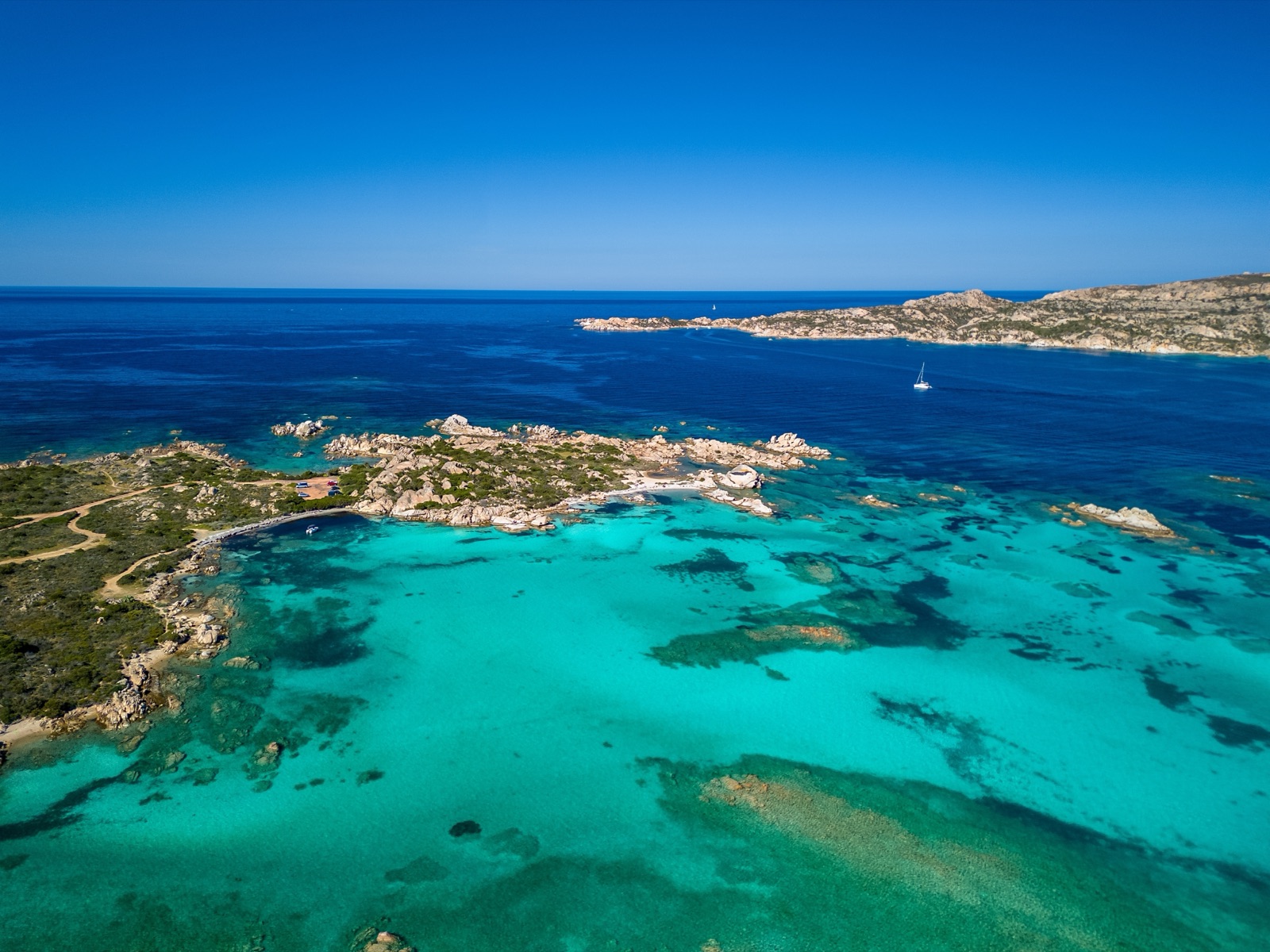
This is where the Costa Smeralda and the archipelago overlap. The islands of Soffi, Nibani and Mortorio, located opposite Porto Rotondo and Porto Cervo, are classified by La Maddalena National Park as TA areas, which the park describes as places of remarkable naturalistic interest.
- Mortorio covers around 12 hectares, with beaches and a cliff.
- Soffi is often chosen for nesting by Audouin’s gull, one of the rarest species in the world.
- Li Nibani are the islets you see from the Pevero beaches.
In practice this means the park’s rules apply here as they do around La Maddalena itself. Boaters need a park permit to navigate, moor, anchor or stop within 300 m of the coast, while kayaks, pedalos and windsurf boards are exempt. If you hire a boat or join a small-boat trip to these islets, the permit is part of the deal; ask whether it is included. Our article on boat hire around La Maddalena explains the permit, speed limits and anchoring rules in detail.
Arzachena: the town behind the coast
Porto Cervo, Cannigione and Baja Sardinia all belong to Arzachena, a small town in Gallura 25 km from Olbia. It became a municipality in its own right in 1922, and its districts include Baja Sardinia, Cannigione, Poltu Quatu and Porto Cervo. The town itself is inland, on the main road north towards Palau, and it is a working town rather than a resort, with the everyday shops the coast lacks.
The area was settled long before the resorts. Near Arzachena is the Li Muri necropolis, from the second half of the fourth millennium BC, and the archaeology also includes the Nuragic complexes of Malchittu and Albucciu and the giants’ tomb of Coddu Vecchiu. If you want a morning away from the beaches, these sites are a short drive from the coast.
Cannigione and Baja Sardinia: the boats to La Maddalena
Cannigione
Cannigione, a hamlet of Arzachena and originally a fishing village, lies on the western side of the largest and deepest ria, or drowned river inlet, in north-east Sardinia. Its seafront is taken up by a large modern port, and Arzachena town is less than ten kilometres away. Its gently sloping seabed has made it one of Sardinia’s leading diving centres. Near the town beach there is parking, equipment and small-boat rental, a bar, a restaurant and places to stay.
Above all, boat trips into La Maddalena archipelago national park leave from Cannigione. The full-day cruise from Cannigione is a three-deck boat with a swim at Cala dell’Amore, 1.5 hours at the natural pools of Porto della Madonna and free time in La Maddalena town. It takes about 8 hours. For anyone staying on the Costa Smeralda without a car, this is often the simplest way to see the islands.
Baja Sardinia
Baja Sardinia was built a few years after the Costa Smeralda boom and is four kilometres from Porto Cervo. It faces the archipelago directly. Boat trips, windsurfing and diving are offered all along the coast here, and you can also rent boats for do-it-yourself tours. Baja Sardinia is one of the ports from which boat trips to the largest islands of the archipelago depart.
Palau
Palau is not on the Costa Smeralda, but it is the key port for the islands: ferries link it with La Maddalena, and most day boats, catamarans and sailing trips leave from its harbour. The catamaran tour with lunch leaves from Palau, with swim stops at three islands, commentary from the captain, a look at the Pink Beach, and lunch with wine, in about 7 hours. Our guide to getting to La Maddalena covers the drive, the ferry timetable and parking.
How it all fits together
Distances on this coast are short, but the roads are winding and slow in August. These are the figures the sources give:
- Olbia to Arzachena: 25 km.
- Olbia to Palau: 40 km; Olbia airport is just over 40 km from Palau.
- Porto Cervo to Baja Sardinia: four kilometres.
- Arzachena to Cannigione: less than ten kilometres.
- Palau to La Maddalena: a short ferry crossing; the island town is just 2 km from the Sardinian shore.
From Porto Cervo, the realistic choices for a day in the archipelago are a boat trip from Cannigione or Baja Sardinia, or a drive to Palau for the ferry or a trip from there. The tours page lists the trips with live prices, and our guide to boat trips and beaches compares them.
Costa Smeralda or La Maddalena as a base?
The two areas suit different trips.
- Stay on the Costa Smeralda if beaches you can reach by car, hotels with services and evenings in Porto Cervo matter most. You will need a boat trip for the islands.
- Stay on La Maddalena if the islands, Caprera and Garibaldi’s house are the point of the trip. La Maddalena has 10,449 inhabitants and a real town life out of season, and the boats to the outer islands leave from its own port as well as from Palau.
- Stay in Palau or Cannigione for a middle way: close to the boats, cheaper than Porto Cervo, and within a short drive of both.
A day that combines both
- Morning: a swim at Capriccioli or Grande Pevero before the beaches fill up.
- Late morning: a walk up to Stella Maris and through the lanes of Porto Cervo.
- Afternoon: drive to Palau and take the ferry to La Maddalena for an evening in the town. Our guide to La Maddalena town and Caprera covers what to see.
- Next day: a full day on the water from Cannigione or Palau, with the Pink Beach seen from the sea and the natural pools of Porto della Madonna.
If you have only one day, do it the other way round: the boat trip is the part you cannot do from the shore.
Practical tips
- Book island trips ahead in July and August, especially the Cannigione cruise and the catamaran from Palau.
- Go early to the named beaches in summer; parking at the smaller coves fills quickly.
- Check which harbour a trip leaves from. “Costa Smeralda” in a trip title can mean Cannigione, Baja Sardinia or Palau.
- Respect the park. The Pink Beach on Budelli is closed and can be seen only from the sea; boats may pass slowly up to the buoys about 70 m from the shore.
Frequently asked questions
Is Porto Cervo part of the La Maddalena archipelago?
No. Porto Cervo is a hamlet of Arzachena on the Sardinian mainland. But the islands of Soffi, Nibani and Mortorio, opposite Porto Cervo and Porto Rotondo, belong to La Maddalena National Park, and boat trips to the archipelago leave from nearby Cannigione and Baja Sardinia.
When was the Costa Smeralda created?
The Consorzio Costa Smeralda was founded on 14 March 1962 in Olbia, with Prince Karim Aga Khan among its six founding partners. The historic core of Porto Cervo, designed by Luigi Vietti, was inaugurated in 1964.
How do I get from Porto Cervo to La Maddalena?
Either join a boat trip from Cannigione or Baja Sardinia, or drive to Palau and take the ferry to La Maddalena town. The full-day cruise from Cannigione takes about 8 hours and includes free time in La Maddalena town.
Which is the best beach near Porto Cervo?
It depends on the day. Grande Pevero is shallow and good for children, Liscia Ruja is the largest and best-equipped, and Capriccioli is sheltered from the mistral. All of them are busy in August, so arrive early.
What is inside the Stella Maris church?
A sixteenth-century Mater Dolorosa by El Greco, given to the church after it was built, and a Neapolitan pipe organ by the De Martino family. The church was designed by Michele Busiri Vici and inaugurated in 1968.